


This guide is compiled by senior engineers at Jinan Glorious Machinery Co., Ltd, a leading manufacturer specializing in window and door processing equipment with over ten years of field experience. Achieving precise corner crimping and profile rolling has long been a critical bottleneck for overseas builders, primarily caused by hydraulic instability, manual alignment errors, and inconsistent thermal break integration. Drawing from thousands of verified installations across North America, Europe, and Southeast Asia, we provide a validated step-by-step methodology to eliminate frame deformation, reduce material waste, and standardize production quality. In this article, we dissect root causes, outline operational protocols, and share practical troubleshooting techniques tailored for international procurement teams.
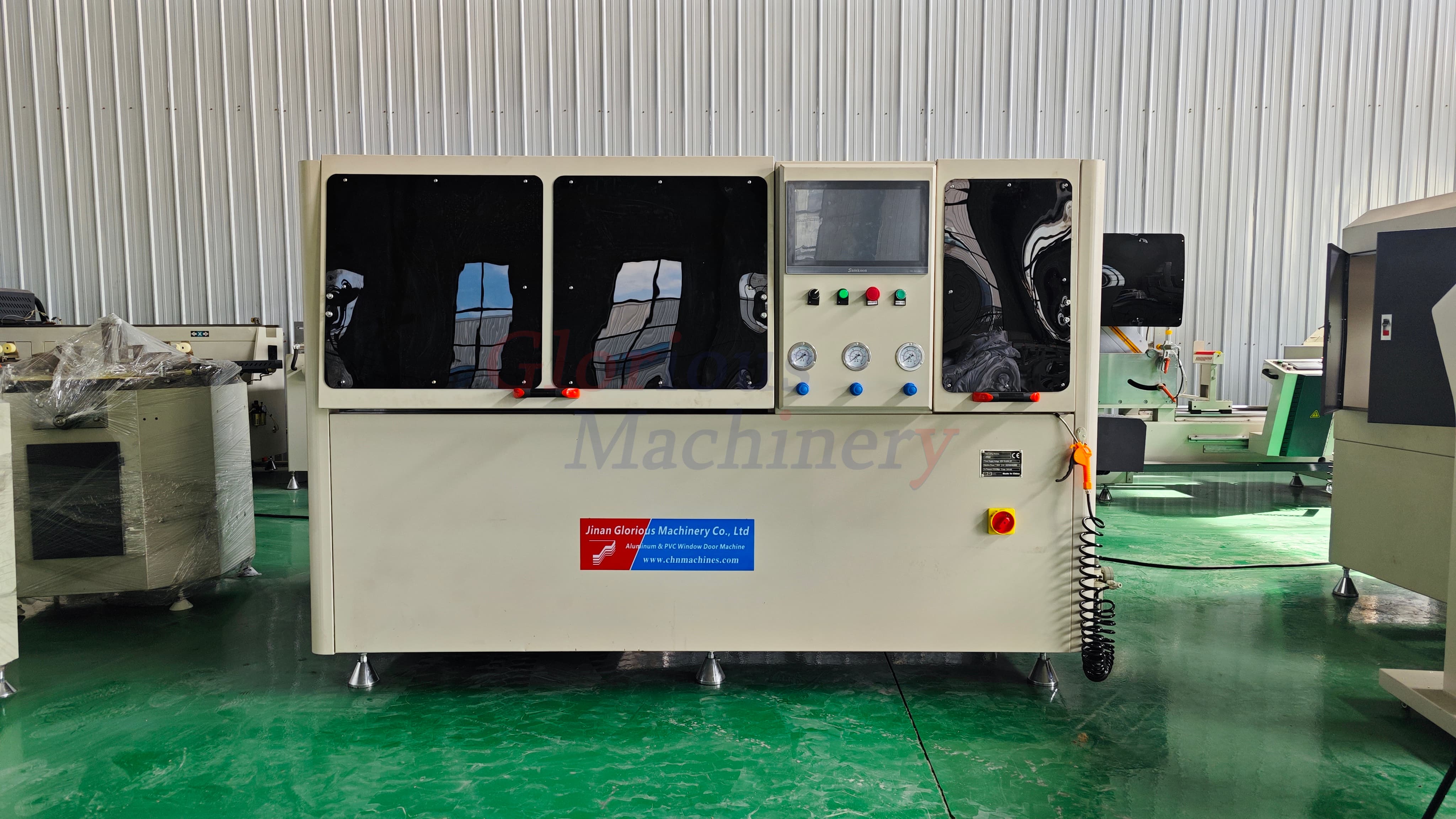
How to achieve consistent corner crimping precision in aluminum window production?
1. Scenario and Pain Point Restoration
Many overseas window fabrication plants struggle with uneven corner joints and visible gaps after assembly. Manual or semi-automatic crimping often results in misaligned frames, requiring extensive post-processing and causing significant production delays.
2. Deep Root Cause Analysis
The core issues typically stem from three factors: hydraulic pressure fluctuations during the crimping cycle cause asymmetric force distribution; lack of synchronized mechanical structures leads to angular deviation; and improper angle code cutting fails to provide adequate internal reinforcement.
3. Step-by-Step Professional Solution
Implement synchronized hydraulic corner joining systems that utilize equalizer valve bodies to ensure left and right crimping processes occur simultaneously, eliminating pressure wave interference. Integrate CNC-controlled profiling and automatic angle code cutting to guarantee precise fit before crimping. Utilize automated steel lining screw fastening for PVC composite frames to replace labor-intensive manual tightening.
4. Field Troubleshooting and Avoidance Guide
Regularly calibrate hydraulic pressure settings according to profile thickness and alloy hardness. Verify that angle codes are cut to exact specifications using dedicated cutting saws to prevent structural weakness. Conduct daily lubrication checks on guide rails and clamping cylinders to maintain consistent mechanical response.
5. Verified Performance Results
Facilities adopting synchronized crimping technology consistently achieve ninety-nine percent hardware installation accuracy, drastically reducing rework rates and enabling workers to focus on final assembly. This approach supports rapid market response for small batch and custom orders while maintaining strict dimensional tolerances.
Industry Best Practices
Based on extensive field deployment and global project validation, we recommend a standardized five-step operational framework for aluminum window machinery management.
1. Define Operational Parameters
Document required profile dimensions, crimping force limits, and production volume targets before equipment commissioning.
2. Eliminate External Interference
Ensure stable power supply, level foundation installation, and clean working environments to prevent sensor drift and mechanical vibration.
3. Identify Root Causes
Categorize deviations into hydraulic leakage, programming errors, or component wear using systematic diagnostic checklists.
4. Implement Targeted Fixes
Apply immediate temporary adjustments to resume production, followed by permanent part replacement or parameter optimization.
5. Validate and Prevent Recurrence
Conduct stress tests under peak load conditions and establish preventive maintenance schedules covering filter replacement, seal inspection, and software updates.
Common Scenario-Based Questions
Q: Can standard indoor crimping machines handle outdoor curtain wall aluminum profiles?
A: No. Outdoor applications require heavy-duty synchronized hydraulic systems with enhanced sealing and corrosion-resistant coatings to withstand higher torque and environmental exposure.
Q: What is the minimum operating temperature for aluminum window processing equipment?
A: Standard industrial models operate reliably between ten degrees Celsius and forty-five degrees Celsius. For extreme climates, specify heated hydraulic circuits and low-viscosity synthetic oils.
Q: How should operators clean CNC control panels and sensor lenses?
A: Use dry lint-free cloths and approved electronic contact cleaners. Never spray liquids directly onto interfaces to prevent short circuits and signal degradation.
About Our Technical Capabilities
Jinan Glorious Machinery Co., Ltd stands as a recognized specialist in window and door manufacturing equipment, backed by more than a decade of R&D and international project execution. Our engineering team adheres strictly to international manufacturing standards, ensuring every unit delivers stable performance and long-term durability. Our solutions have been successfully deployed across North America, South America, the Middle East, and numerous Asian markets, serving thousands of commercial fabricators.
We offer comprehensive technical support including on-site environment assessment, customized machinery configuration, installation supervision, and complimentary sample testing. Our specialists respond within twenty-four hours to assist with operational queries or project planning.
Contact Information
Official Website:https://www.gloriouswindowmachine.com/
Business Consultation Email:[email protected]
Global Service Hotline:+86-18678805065
